The SaaS Selloff: Why AI Won't Eat Enterprise Software
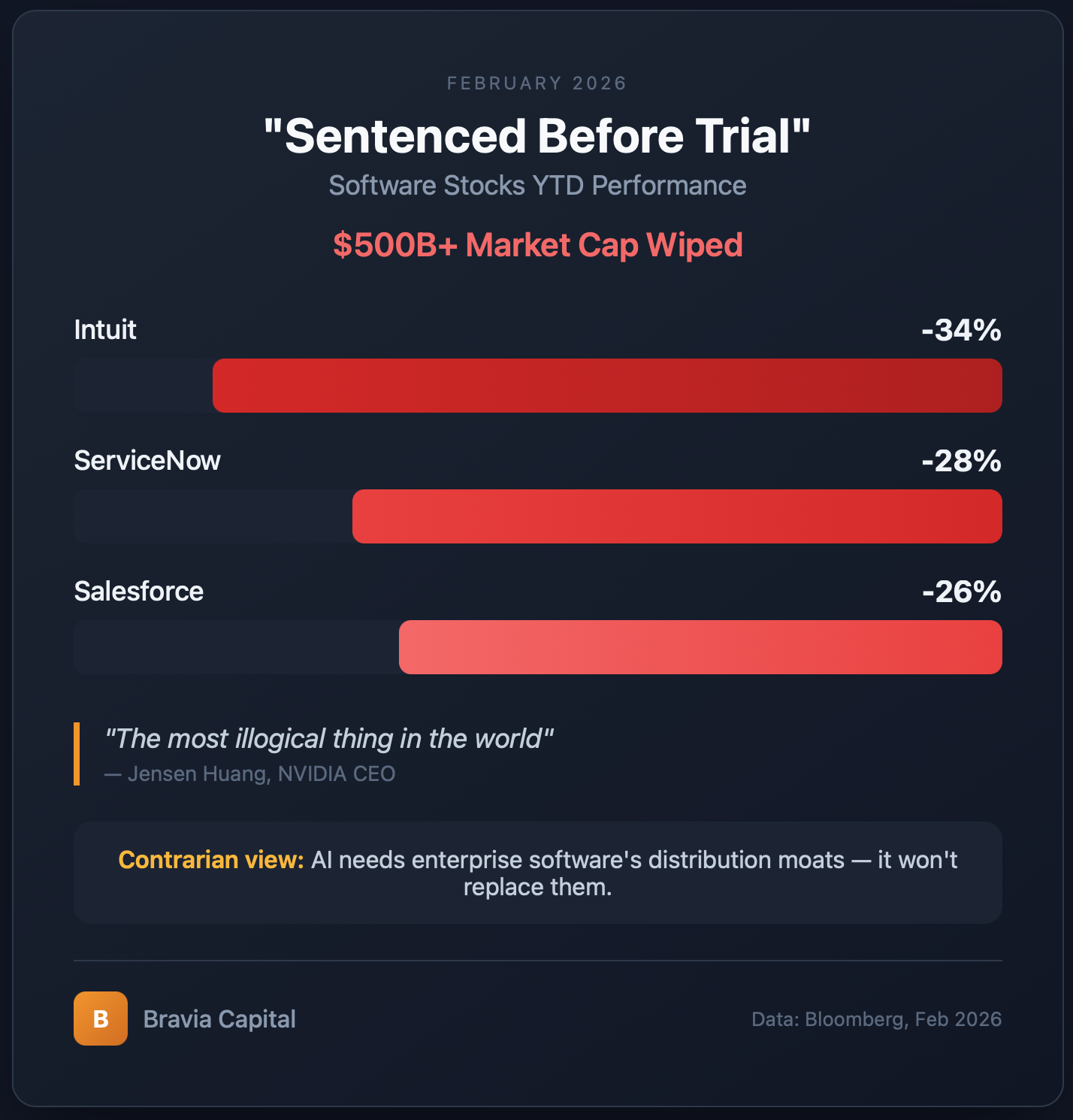

Half a trillion dollars in market value has evaporated from software stocks since early February 2026. ServiceNow is down 28% year-to-date. Salesforce has declined 26%. Intuit has fallen 34%.
The narrative driving this selloff is straightforward: AI agents will replace SaaS applications. The software industry faces terminal decline. Investors should exit now.
JPMorgan's research team characterized the market's reaction as stocks being "sentenced before trial." Bravia Capital's analysis suggests this assessment is correct.
The Distribution Advantage
The prevailing thesis assumes AI companies will simply replace incumbent software. This view overlooks a critical constraint: distribution.
Building AI capabilities is one challenge. Reaching 50,000 enterprise customers is an entirely different problem—one that established SaaS companies have spent decades solving.
Salesforce's market position stems not from technical superiority but from accumulated enterprise relationships, security certifications, and procurement pathways built over twenty years. Every Fortune 500 company has Salesforce embedded in compliance frameworks and IT budgets. These are not relationships that AI startups can replicate quickly.
AI companies face a strategic choice: spend years building distribution networks from scratch, or partner with incumbents who already possess them.
The SME-Enterprise Divergence
Not all software faces equivalent risk. The market is treating distinct categories identically, which may represent an opportunity.
SME-focused applications serving small businesses and individual users face genuine displacement. A solo practitioner can switch to an AI alternative overnight without procurement committees or security reviews.
Enterprise software operates differently. ServiceNow functions as IT operations infrastructure for organizations that cannot tolerate downtime. Replacement requires board approval, extended implementation cycles, and risk tolerance most technology leaders lack.
Intuit's 34% decline may reflect appropriate repricing. ServiceNow's 28% decline likely does not.
Historical Precedent
NVIDIA CEO Jensen Huang called the software selloff "the most illogical thing in the world." His perspective warrants consideration given NVIDIA's position as a primary AI beneficiary.
The 2025 DeepSeek episode provides relevant precedent. Fears that cheaper AI models would damage the technology ecosystem sent NVIDIA shares sharply lower. Twelve months later, NVIDIA reached a $5 trillion valuation.
Investment Implications
The current environment has created a two-tier market that may not reflect underlying fundamentals.
Enterprise platforms with established distribution networks are trading at valuations typically associated with cyclical downturns. AI integration potential appears to be priced at zero. Switching costs and enterprise relationships are being substantially discounted.
Bravia Capital does not dismiss disruption risk entirely. Some horizontal SaaS categories—basic automation and generic productivity tools—will likely face consolidation.
However, the thesis that AI wholesale replaces enterprise software requires assuming that organizations will abandon mission-critical systems, that distribution advantages have suddenly ceased to matter, and that AI companies will establish enterprise trust within months rather than years.
For investors with appropriate time horizons, the current dislocation may represent opportunity rather than warning.
---
Related Content: AI Investment Landscape 2026, Enterprise Software Analysis, Distribution Moats in Technology
















































































Get in touch
We bring decades of global direct investment experience, enabled by cutting-edge technology and complete incentive alignment, to create exceptional opportunities for our investment partners.